"Helping woodworkers online for over 20 years"
Measuring Tools 101
Steel Rule • Tape Measure • Calipers
|
See Also:
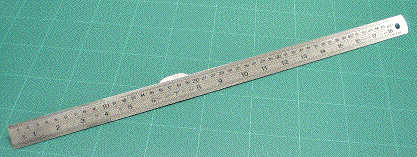
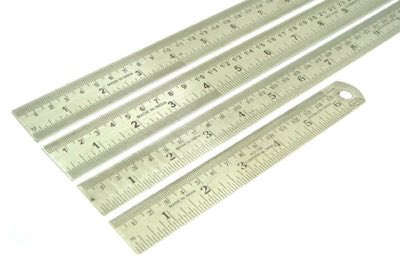
A good quality steel rule has many uses, drawing plans, measuring material, checking if glue ups are flat, aligning table saw wings, and any other application where accuracy is necessary. They are available in various lengths, some have the markings starting from the edge, others are indented, these are better for precise measurment since damage to the end will not affect the reading. They are available with many different scales, often with a combination of imperial on one side and metric on the other. An Imperial rule may have inch graduations in 10ths, 16ths, 32nds, or 64ths, some may have only the first few inches marked in 64ths.
A thinner rule will give a more precise reading because the scale is closer to the material being measured, a thicker rule is less flexible so is often handier to check for straightness.
Folding Rule
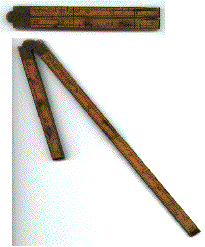
I would like to say that this old wood and brass 24" folding rule had been handed down to me, the truth is I bought it at a garage sale recently for 25 cents. Some craftsmen still rely on these rules today, however they have been mostly replaced by the tape measure.
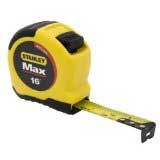
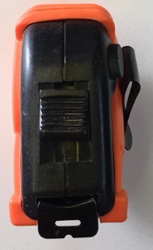
Tape measures come in a variety of widths and lengths, I would not recomend anything less than 3/4" wide for a tape over 6 feet long as they can not be extended out and remain rigid. For small projects in the shop 1/2" wide ones are adequate. Some have highlighted indicators at each foot, others have them at 16 inch intervals which is handier in construction for stud layout, whereas the foot indicators are more useful in the shop. Special tapes are available for lefties as well as ones with digital read-outs.
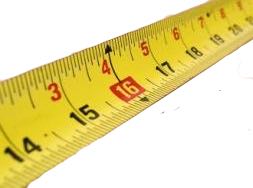
On a standard tape measure with inch and foot markings the scale between the inch markings is divided into 1/16" divisions, the longest lines represent 1/2", the next longest 1/4", then 1/8" and finally 1/16". The red numbers at the top indicate the number of inches past the last foot mark.
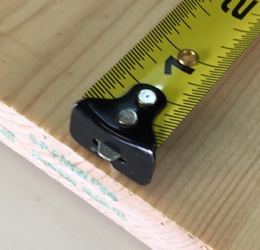
The hook on the end is meant to be loose so that it will give an accurate measurement whether it is hooked over the edge or butted up to an edge. Check if the hook has been bent if measurments are not accurate. Most tapes have a slot in the end
of the hook, this is meant to hook over a nail or screw to
hold the end of the tape when measuring over long distances.
Why Most Tape Measures Read From Left To Right The graphics on the blade were designed for a right-handed person to measure, so consequently it is awkward use it to mark with. To measure the user hooks the blade to his left and pulls the tape to his right with his right hand, the numbers are right side up. To measure and mark it is necessary to either hold the tape case in the left hand and cross-over with the right to mark, or measure from right to left putting the numbers upside-down. Years ago Stanley attempted to remedy this situation by putting the numbers on both sides of the tape so they read right-side up from either edge. Due to an enormous amount of complaints from users saying it was too confusing and caused errors they discontinued the idea. Vernier Calipers
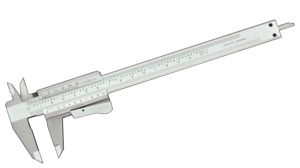
Vernier calipers are generally considered a metal working machinists tool, however a basic model is very useful in the woodworking shop. They will allow you to accurately measure inside dimensions, thickness and depth. They come in several styles, some with a dial gauge, others with a digital readout that will read in either metric or imperial. Joint Calipers
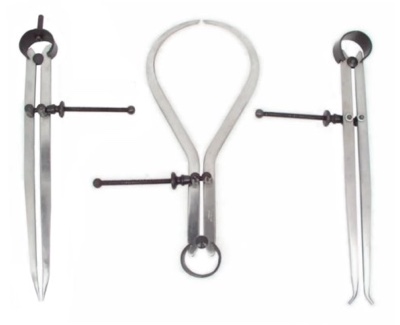
Joint calipers are used mostly by turners, shown are dividers, outside measuring and inside measuring styles. They are used to give a duplicate measurement, rather than determining the size being measured as when using Vernier style calipers.
|